
Blog

The Latest E-Shop Marketing Breakthroughs Using AI for 2026 (And How to Apply Them)
AI isn’t “nice to have” anymore in e-commerce marketing—it’s becoming the default operating layer for how customers discover products, how ads are built, and how performance is optimized.
In 2026, the winners won’t be the stores that “use AI,” but the stores that build repeatable systems where AI accelerates strategy, testing, and conversion growth.
One signal is impossible to ignore: AI-driven traffic to retail sites surged 693% year over year during the 2025 holiday season, indicating shoppers are increasingly discovering products through AI assistants—not only search and social
1) AI Shopping Assistants Are Becoming the New “Search.”
Discovery is shifting toward AI-first journeys: people ask a chatbot what to buy, compare options inside an assistant, and only then click through to a store.
Google has expanded shopping capabilities inside Gemini via partnerships with major retailers, pushing commerce toward “assistant-led” shopping flows.
What this means for your e-shop in 2026
Your product pages must answer questions AI assistants care about: use cases, sizing, compatibility, comparisons, shipping/returns, and trust signals.
“Zero-click” discovery is rising: your brand may be recommended before the customer ever sees your homepage—so your product data and positioning must be consistent everywhere.
Action steps
Add FAQ blocks to key product/category pages (returns, delivery, sizing, warranty, materials).
Create comparison pages (“X vs Y”) and “best for” pages (intent-driven SEO).
2) Agentic AI + Unified Commerce Is the Next Big Leap
2026 is the year AI moves from answering questions to taking actions within rules (agentic AI)—but only when your store data is unified (inventory, orders, pricing, customer signals).
This trend is increasingly highlighted in commerce predictions for 2026.
Practical takeaway
If your tracking, catalog, and product feeds are messy, AI-driven optimization becomes unreliable. Your “data hygiene” becomes a growth lever.
3) Ads Are Becoming “AI-Assisted Systems,” Not Manual Campaigns
Meta: Advantage+ and creative automation
Meta continues pushing Advantage+ as a streamlined, AI-driven approach for Facebook/Instagram campaigns.
This changes how you win:
More weight on creative volume + testing structure
Less obsession over micro-targeting (AI does more of that)
Stronger need for conversion-focused creative frameworks
Google: Performance Max is adding more controlled testing
A major shift for 2026 is structured A/B testing for creative assets inside Performance Max (beta)—helping advertisers validate which creative set truly performs better.
What to do in 2026
Build campaigns around testing angles, not just “one perfect ad.”
Prepare 2–4 creative “sets” (hooks + offers + visuals) and test systematically.
Use clean conversion tracking (see Section 6) so AI optimization has reliable signals.
4) Generative Creative Is Exploding—But Brand Control Matters
AI can generate variants faster than any team. The advantage goes to stores that:
Keep a consistent brand voice
Use a repeatable “creative recipe” (Hook → Value → Proof → CTA)
Apply human review so ads don’t feel generic or off-brand
Your 2026 creative stack
UGC–style video ads + product demos + fast-cut benefit ads
AI-assisted scripting + AI-assisted variations
Human-led strategy and final polish
5) Shopify and E-Commerce Platforms Are Embedding AI Natively
Shopify has been expanding built-in AI capabilities (e.g., generating content inside the admin) and has rolled out AI-driven experiences to simplify store creation and operations.
What matters for marketing
Faster product-page creation (but you must edit for persuasion + SEO)
Faster email/SMS drafting (but you must optimize for conversion)
Faster merchandising decisions (but you still need strategy)
6) Measurement, Privacy, and “Trustworthy Data” Become Competitive Advantages
In 2026, you can’t scale profitably without clean measurement—especially as platforms automate more decisions.
Key moves
Ensure your tracking and consent setup is modern (many brands adopt Consent Mode practices to maintain measurement while respecting user choices).
Don’t rely on last-click only. Push toward incrementality thinking (what truly caused extra sales, not just what got credit).
7) Compliance and Transparency Around AI Content Is Rising
If you operate in the EU (or market to EU customers), transparency expectations are increasing. The EU’s AI regulatory framework includes transparency rules for certain AI-generated or manipulated content, with timelines that matter for 2026 planning.
Practical brand-safe approach
Be careful with synthetic “real person” style ads.
Keep internal guidelines for when AI is used and who approves outputs.
A Simple 2026 AI Growth Plan for Your E-Shop
If you want a clean execution path:
Fix measurement (GA4/GTM + conversion events + clean funnel tracking)
Build 3–5 high-intent landing pages (category + best-for + comparison)
Launch structured ad testing (2–4 creative sets)
Scale winners with Advantage+ / Performance Max + retargeting
Add AI-assisted content production (but keep human strategy and QA)
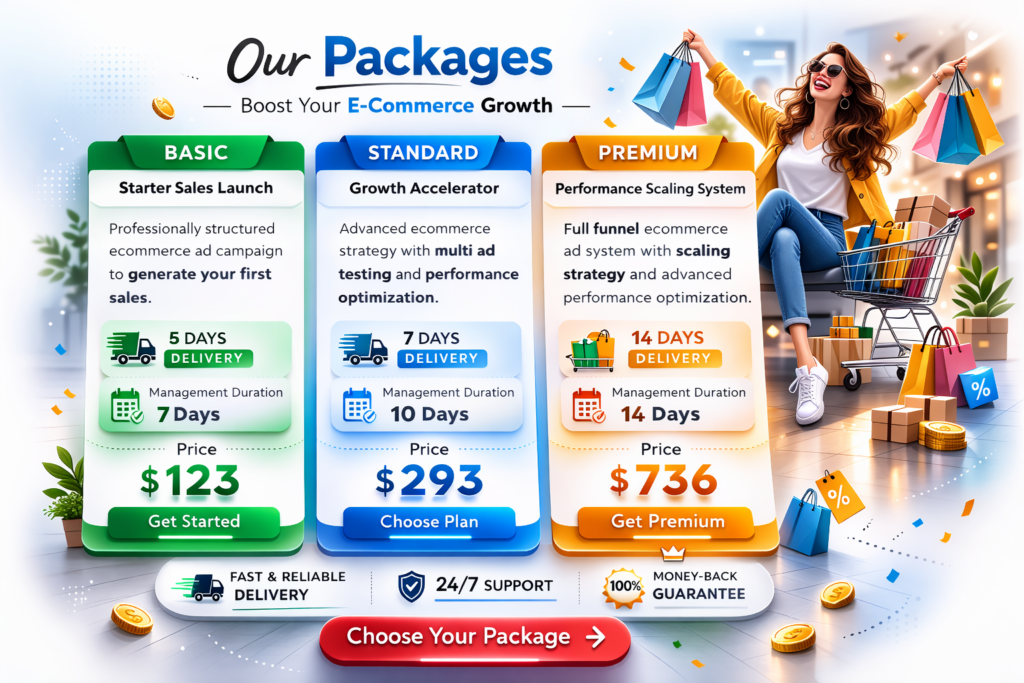
Below, you can see our structured e-commerce ad campaign packages designed for 2026 growth.
Our Services (Digital Bee by Billy Kasis)
If you want this implemented professionally, here’s what we deliver:
E-Shop Ads Packages (Facebook & Instagram / Google)
Starter Sales Launch: structured launch to generate first sales
Growth Accelerator: multi-ad testing + optimization framework
Performance Scaling System: full-funnel strategy + scaling structure
Video Ads for E-Commerce (2026 Conversion Structure)
Hooks that stop the scroll
Conversion-focused scripting
Creative variations for testing
Platform-ready formats (Reels/Stories/Feed/Shorts)
Tracking & Performance Setup
GA4 + key events (purchase, add-to-cart, initiate checkout)
Reporting structure & improvement roadmap
Campaign optimization based on real signals (not guesswork)
📚 Sources & Industry References
1) Adobe Digital Insights – Online Shopping Trends Report
Adobe Business. (2025). Holiday Shopping Trends & AI-Driven Commerce Growth Report.
2) European Commission – Artificial Intelligence Regulatory Framework
European Commission.
AI Act & Regulatory Framework for Artificial Intelligence.
Written by Billy Kasis – Digital Marketing & E–Commerce Advertising Specialist.
Specialized in structured performance-driven campaigns for online stores.
Update: February 2026
Share this post: on Twitter on Facebook